A Guide to Sicily’s Iconic Symbols and Cultural Traditions

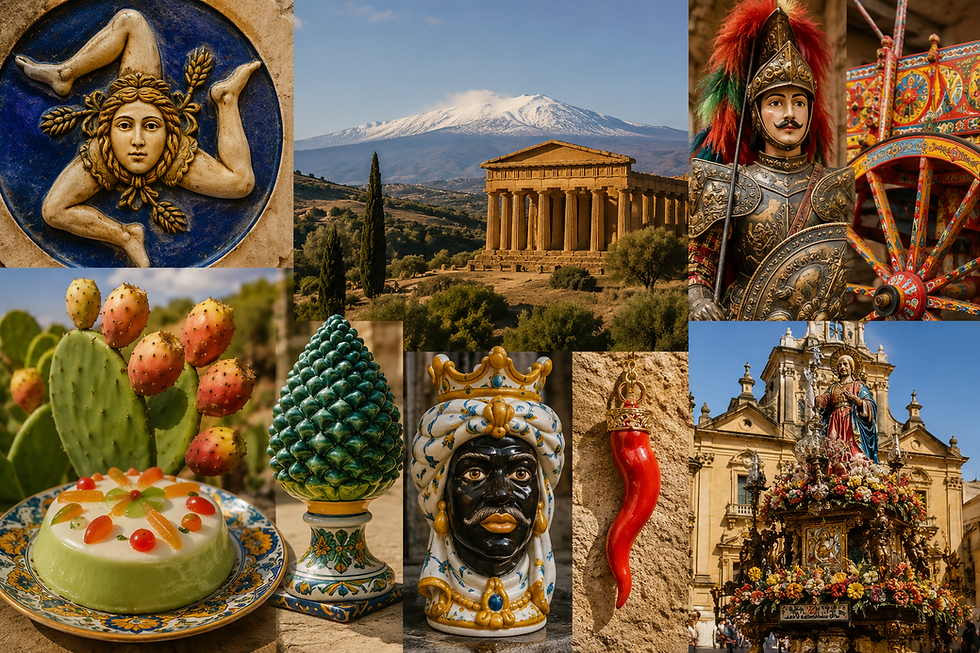
Sicily doesn't just sit at the crossroads of the Mediterranean; it wears that history on its sleeve. Every mosaic, every puppet theater, every ceramic head grinning down from a balcony tells you something about the people who have called this island home for thousands of years. Greeks, Romans, Arabs, Normans, Spaniards—they all left fingerprints here, and somehow Sicily folded all of it into something unmistakably its own.
If you've ever wondered why a three-legged head shows up on flags, tea towels, and taxi doors across the island or why you keep seeing painted carts in gift shop windows, this guide is for you. We're breaking down the real meaning behind Sicily's most recognizable symbols and the traditions that keep them alive today.
Why Sicily's Symbols Matter So Much
Before we get into specifics, it helps to understand something about the Sicilian mindset. This is an island that has been conquered, occupied, and ruled by outsiders more times than most historians can neatly count. Rather than losing its identity in the process, Sicily absorbed each new influence and turned it into folklore, food, art, and ritual.
That's really the story behind Sicily's symbols and meanings; they're not decoration for decoration's sake. They're shorthand for survival, resistance, faith, and pride, passed down through generations of families who wanted their children to remember where they came from.
The Trinacria: Sicily's Most Famous Emblem
Start with the one everyone asks about first: the Trinacria. It's a face, sometimes serene, sometimes fierce, with three bent legs radiating outward and often three wheat stalks or snakes framing the head like hair.
The name itself comes from the Greek word for "three-pointed," a nod to the island's triangular shape and its three capes: Peloro, Passero, and Lilibeo. The Greeks who settled Sicily in antiquity are usually credited with popularizing the image, though similar three-legged motifs (called triskeles) appear in other ancient Mediterranean cultures too.
The face at the center is typically identified as Medusa, though over the centuries her expression softened from monstrous to almost maternal in many depictions, a small but telling shift that mirrors how Sicilians have reshaped inherited symbols into something gentler and more their own. The wheat stands for the island's fertility and its long history as a breadbasket of the ancient world.
Today the Trinacria appears on the official regional flag, on ceramics, jewelry, car decals, and street art from Palermo to Catania. Among the various Sicilian symbols travelers encounter, it's the one that shows up first and stays with you longest.
Quick facts worth knowing:
Name origin: From the Greek word for "threepointed," referencing the island's triangular shape
The three legs: Represent Sicily's three ancient capes — Peloro, Passero, and Lilibeo
The face: Usually identified as Medusa, though her expression has softened over centuries of reinterpretation
The wheat stalks: Symbolize fertility and Sicily's role as an ancient breadbasket
Where you'll see it: The regional flag, ceramics, jewelry, car decals, and murals across the island
Teste di Moro: The Moor's Head Ceramics
Walk through almost any Sicilian town, and you'll spot them on balconies and windowsills: ornate ceramic heads, usually sold in pairs (one male, one female), often adorned with crowns of fruit, flowers, or vegetables.
These are Teste di Moro, and the legend behind them is dramatic. The most popular version tells of a young Sicilian woman in Palermo who fell for a Moorish traveler. When she discovered he already had a wife and family waiting for him back home, she killed him in his sleep and, in her grief and fury, kept his head as a planter for basil on her balcony, a plant that supposedly grew lush and fragrant because of it. Neighbors, envious of her thriving garden, commissioned ceramic versions of the head to display their own.
Whether or not you take the folklore at face value, the Teste di Moro remain one of the most photographed examples of symbols of Sicily, and skilled ceramicists in towns like Caltagirone still handpaint them using techniques passed down for generations.
The Sicilian Cart (Carretto Siciliano)
Before cars and trucks, Sicilian farmers transported goods on wooden carts painted with dazzling detailed scenes from chivalric legends, religious stories, or local history, framed by bright reds, golds, and greens.
Building and painting a proper carretto was a genuine craft, requiring a woodworker, a blacksmith, and a painter working together. Owning a beautifully decorated cart wasn't just practical; it was a quiet display of pride and status. You'll still find full-size carts on display in museums in Taormina and Palermo, and miniature painted versions make popular souvenirs precisely because they capture so much of the island's visual storytelling tradition in a single object.
Opera dei Pupi: Sicilian Puppet Theatre
If the carretto tells stories in paint, the opera dei Pupi tells them in motion. This traditional puppet theater, recognized by UNESCO as part of humanity's intangible cultural heritage, features hand-carved marionettes, often in full armor, acting out tales of knights, honor, and battle drawn from medieval chivalric poems.
The puppets themselves can weigh several kilos and require skilled puppeteers who train for years to manage the metal rods and strings convincingly. Performances still take place in small theaters in Palermo and Catania, and watching one is one of the more immersive ways to understand how deeply Sicilians value storytelling as a form of cultural memory.
Food as Symbol: Cannoli, Arancini, and the Sicilian Table
It would be impossible to talk about Sicilian identity without mentioning food, because on this island, food is culture. Cannoli crisp pastry shells filled with sweetened ricotta trace back to Arab-influenced pastry traditions and were historically associated with Carnival celebrations before becoming an everyday treat.
Arancini, the fried rice balls stuffed with ragù, cheese, or pistachio, are said to have Arab origins as well, with the rice itself introduced to the island during Arab rule in the ninth century. Even the shape carries meaning in some regions, with rounder arancini in the west and more cone-shaped versions near Catania, supposedly echoing Mount Etna.
A few other dishes carry cultural weight beyond their flavor:
Cassata siciliana — a marzipan and ricotta cake historically reserved for Easter celebrations
Pane e panelle — Palermo's chickpea fritter sandwich, a working-class staple turned street food icon
Frutta martorana — almond paste shaped and painted to look like fruit, traditionally made for All Souls' Day
Couscous alla trapanese — a fish couscous dish from western Sicily that speaks directly to the island's Arab and North African ties
Festivals and Religious Traditions
Sicily's calendar is dense with festivals that blend Catholic devotion with older, preChristian customs. The Feast of Saint Agatha in Catania each February draws hundreds of thousands of devotees who pull an enormous silver reliquary through the city streets in an act of collective faith and endurance. In Palermo, the Feast of Santa Rosalia in July fills the city with processions, fireworks, and street food, honoring the patron saint who is believed to have saved the city from plague.
These festivals aren't staged for visitors; they're lived traditions, and that authenticity is exactly what makes witnessing one so memorable.
A few dates worth planning a trip around:
February 3–5, Catania — Feast of Saint Agatha, one of the largest religious festivals in the world by attendance
July 10–15, Palermo — Feast of Santa Rosalia ("U Fistinu"), with processions, fireworks, and citywide street food
Holy Week (Easter), Trapani — the Processione dei Misteri, an hourslong procession of handcarved statues dating back centuries
Carnival season, Acireale — elaborate flower-covered floats and papier-mâché sculptures
Experiencing These Traditions in Person
Reading about these symbols is one thing; standing in a ceramics workshop in Caltagirone watching a Testa di Moro take shape or hearing the clang of puppet armor in a Palermo theater is another entirely. For travelers who want a deeper, more curated look at the island's heritage rather than a rushed checklist of sights, private and smallgroup Sicily luxury tours are increasingly popular. The right itinerary can take you beyond the postcard image of the Trinacria and into the workshops, kitchens, and festivals where these traditions are still very much alive.
If you're planning a trip and want an itinerary built around Sicily's real cultural fabric, not just its beaches, reach out to a specialist who knows the island from the inside. Classic Sicily has spent years crafting bespoke journeys that connect travelers with artisans, historians, and local families who keep these traditions going.
Frequently Asked Questions
What is the main symbol of Sicily?
The Trinacria is widely considered the main symbol of Sicily. It's a face with three bent legs radiating outward, representing the island's triangular shape and its three ancient capes, and it appears on the official regional flag.
What does the three-legged head on the Sicilian flag mean?
The three legs represent Sicily's triangular geography and its three historic capes Peloro, Passero, and Lilibeo. The face at the center is generally identified as Medusa, and the wheat stalks surrounding it symbolize the island's agricultural abundance.
What is the meaning behind the Teste di Moro ceramic heads?
The Teste di Moro, or Moor's Head ceramics, come from a folk legend about a Sicilian woman and a Moorish traveler that ends in tragedy. Today the paired ceramic heads are seen as symbols of beauty, passion, and Sicily's layered cultural history rather than a literal retelling of the story.
Are Sicilian puppet shows (Opera dei Pupi) still performed today?
Yes. Traditional puppet theaters still operate in cities like Palermo and Catania, and the art form is recognized by UNESCO as part of humanity's intangible cultural heritage.
What's the best way to experience Sicily's traditions as a visitor?
Beyond visiting museums and workshops independently, many travelers choose guided or private experiences, including Sicily luxury tours, that build in visits to ceramic ateliers, puppet theaters, and local festivals rather than just the major landmarks.
Final Thoughts
Sicily's symbols aren't relics gathering dust in a museum case. The Trinacria still flies from balconies, the Teste di Moro still guard front doors, and the puppet theaters still open their curtains most weekends. Understanding what these images and rituals actually mean turns a simple holiday into something closer to a conversation with the island itself, one that's been going on for thousands of years and shows no sign of stopping.
Ready to see it for yourself? Get in touch to start planning a Sicily itinerary built around the island's real stories, not just its scenery.


Comments